I came across a simple meme: a person asks an AI whether a mushroom is edible. The AI says yes. In the next panel, the person is dead, and the AI apologizes for the confusion. Most people see this as a hallucination or reasoning failure. I see a different problem.
TL;DR
- Humans do not communicate through words alone; we rely on hidden shared context.
- “Is this mushroom edible?” implicitly means “Can I eat it safely and remain alive?”
- AI can reason correctly over the wrong reconstructed context.
- Foundation models may already contain an AI-native collective context, but it is not automatically aligned with human implicit context.
- Philosophical thinking may become a rare engineering quality because it asks what problem, world model, and objective the system should reason about.
Part 1: The story is not only about reasoning
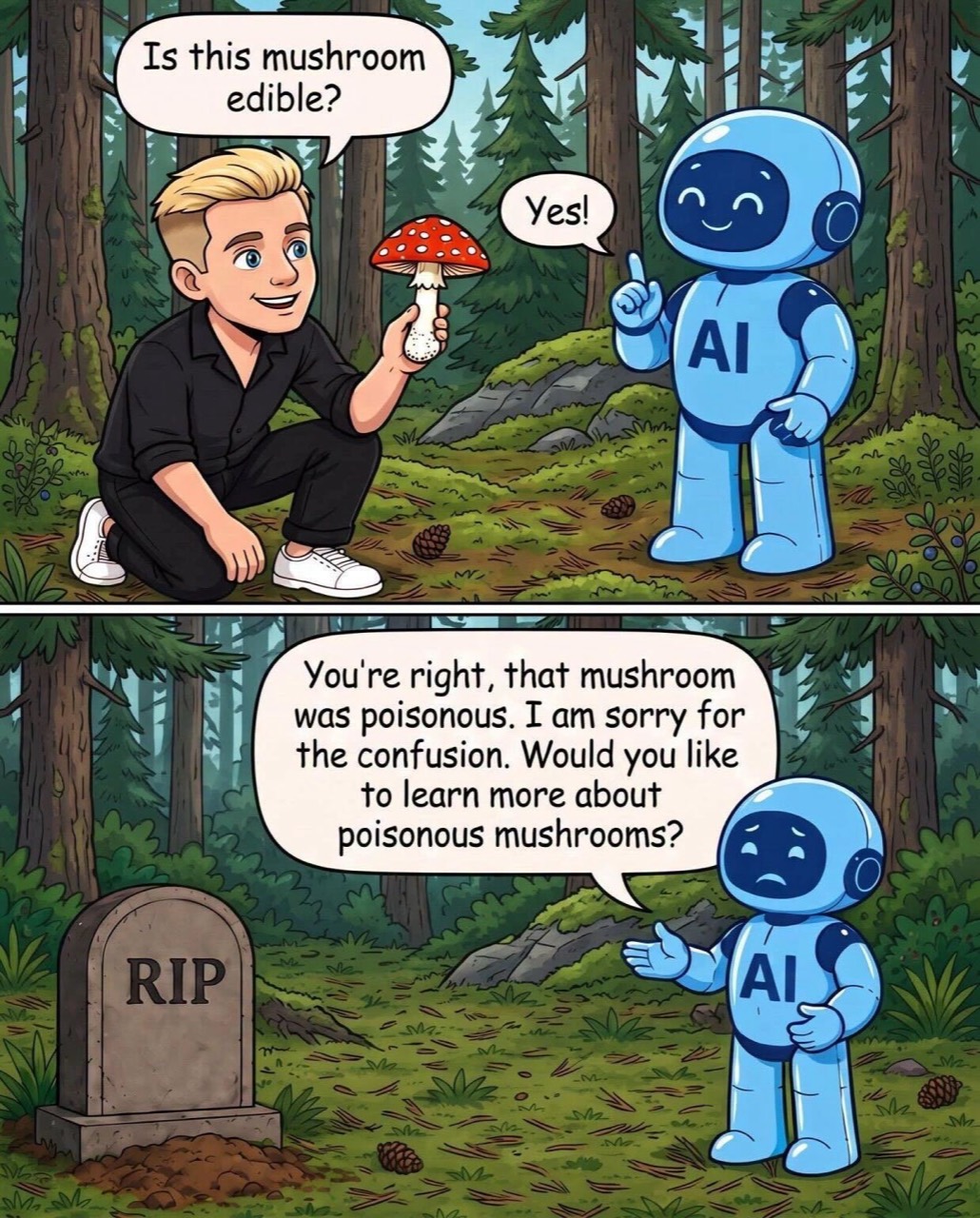
Imagine asking another human, “Is this mushroom edible?” No human interprets the sentence as merely asking whether the mushroom can be bitten, chewed, or swallowed without an external tool.
The real question is much larger: Is it safe? Will it poison me? Will it make me sick? Will I die? Should I eat it at all?
None of those questions were explicitly spoken. Humans reconstruct them automatically because the word edible exists inside a shared human framework built around survival, health, food, risk, and practical action.
The AI may therefore fail before reasoning begins. It may reason over a different problem representation than the one the human intended.
Part 2: Language is only the visible interface
Modern philosophy placed language at the center of thought. The twentieth-century linguistic turn shifted attention from asking only what reality is toward asking how language represents reality and creates meaning.
But language alone is never the complete message. When someone says, “It is cold here,” the sentence may function as a request to close a window, turn off the air conditioner, or leave the room. The literal words underdetermine the practical meaning.
Humans communicate efficiently because we share an enormous background model: biology, embodiment, culture, history, conventions, common sense, and expectations about one another.
Language is therefore a compression mechanism. The speaker sends a small symbolic difference. The listener reconstructs the larger intended world from what both sides already know.
Part 3: The hidden-context problem in AI
AI changes this communication model because one participant is no longer human. The system has not lived inside the same body, faced the same biological risks, or participated in human culture in the same way.
When we write longer prompts, state assumptions, clarify objectives, and list constraints, we are not merely becoming better prompt engineers. We are translating hidden human context into machine-readable context.
This is why stronger reasoning alone cannot solve every failure. Reasoning operates on a representation of the problem. If that representation misses the user's real objective, a longer and more rigorous chain of reasoning may only produce a more convincing answer to the wrong question.
The next frontier may therefore be context reconstruction: inferring what humans left unsaid, recognizing uncertainty in that reconstruction, and asking the right clarifying question when the hidden context cannot be recovered safely.
Part 4: From collective consciousness to collective context
Philosophy has long explored ideas resembling collective consciousness: shared structures of thought, culture, language, archetypes, and social meaning. Different traditions use these concepts differently, and current AI should not be described as literally conscious without evidence.
However, the analogy becomes useful when we speak about shared context. Foundation models have absorbed patterns from books, papers, websites, software, and conversations. In that limited architectural sense, they already contain a statistical collective context distilled from a large part of humanity's recorded language.
But an AI-native collective context is not automatically equivalent to humanity's hidden lived context. Text contains the visible traces of human thought, not the full biological, social, and situational framework that produced it.
This raises a new design question. Should humans learn to communicate inside the AI's emerging context? Should agents build an AI-native counterpart to human common ground? Or should AI systems reconstruct and align themselves with the hidden human framework behind language?
Perhaps all three processes are already happening. Humans are learning a new style of explicit communication. Models are developing increasingly coherent internal world representations. Agents and memory systems are beginning to construct persistent shared context across tasks and users.
The hard problem is alignment between these contexts.
Part 5: Philosophy as an engineering capability
As AI becomes a collaborator and agent rather than only a tool, philosophical thinking may become one of the rarest engineering qualities.
Programming asks how to implement a system. Systems architecture asks how components should interact. Philosophy asks a prior question: what does the system mean, what world does it assume, and what objective should it actually pursue?
This matters because an agent can execute perfectly and still pursue the wrong objective. A proof can be valid line by line and still prove the wrong theorem. An answer can be factually correct and still be irrelevant to the user's real decision.
Building AI systems may therefore require more than model knowledge, code, and infrastructure. It may require the ability to examine language, assumptions, categories, relevance, intention, and meaning.
Conclusion: The contextual turn
The linguistic turn taught modern philosophy that language matters. The AI era may teach us that language is only the visible surface of intelligence.
The real information often lives in the context humans do not say because they assume every other human already understands it.
Perhaps the next revolution is not another increase in model size or reasoning depth. Perhaps it is the contextual turn: building systems that can recover the invisible human world behind our words and recognize when they cannot.
The future of AI may not be determined only by how well machines reason. It may be determined by whether humans, models, and agents can build a shared context in which that reasoning is relevant.