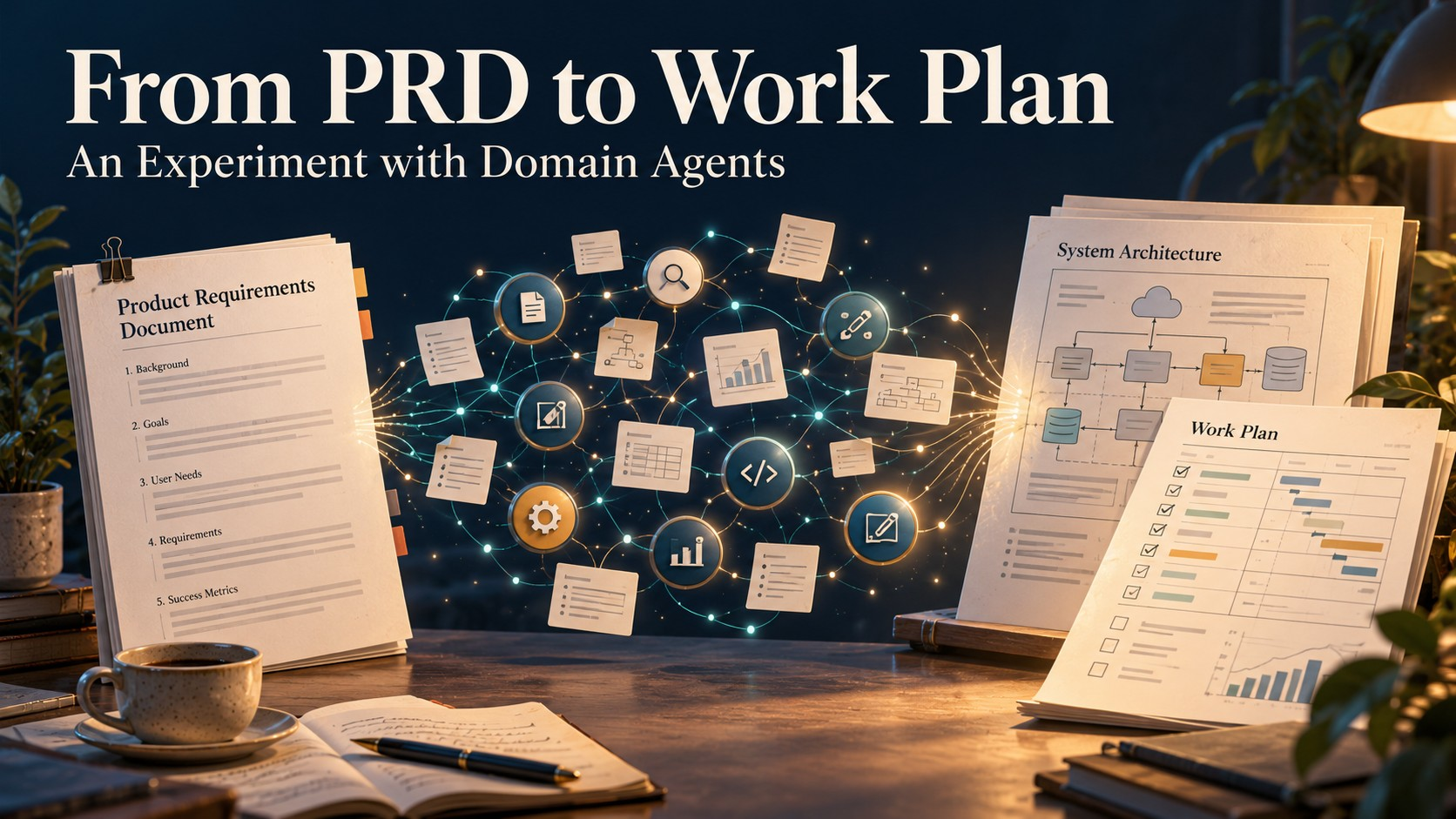
Recently, I have been experimenting with whether an agent fleet can complete complicated professional work, such as turning a complex PRD directly into a detailed work plan.
This is an experiment, not a service or product. I am sharing the process and what I hope to learn.
For this example, the task is planning a migration to cloud services. The idea is to give agents domain skills, clear responsibilities, and a shared goal, then see how well they can work together.
The workflow
1. Start with 100 agents
Set up the fleet with empty soul and scope definitions.
2. Propose the team
Ask local Codex to carefully read the relevant domain skills repository and generate a JSON roster with each agent’s name, role, scope, and skills.
3. Initialize the fleet
Populate each agent’s soul and scope from the roster, establishing its professional identity and responsibilities.
4. Build initial memory and focus
Run a check-in. Ask each agent to load its domain skills and report what it can do and what it should contribute. This builds the fleet’s initial memory and focus around the project.
5. Establish the working graph
Give local Codex or Pi the initial architecture and goal. Ask it to build a dynamic graph with dependencies, parallel work, and collaboration and revision loops.
6. Turn the PRD into a work plan
Read this PRD carefully and collaboratively produce a detailed work plan. Include architecture, cloud service mapping, requirement coverage, gaps, assumptions, dependencies, risks, actions, ownership, implementation phases, deliverables, and acceptance criteria. Clearly identify unresolved questions.
7. Run another revision loop
Feed the design, PRD, and resulting work-plan DOCX back into the fleet:
Read the design, PRD, and work-plan DOCX carefully, and collaboratively revise the work plan. Resolve inconsistencies, close gaps, expand implementation details, and clearly identify anything still unresolved.
What I am looking for
I am particularly interested in whether the agents connect decisions across domains. Does a networking constraint appear in the deployment plan? Does a storage decision carry through to the recovery strategy? Can the team explain how its proposed services satisfy the original requirements?
The revision loop gives the agents another opportunity to work through these connections and make the plan more concrete. Implementation can then provide evidence about how well the design holds up.
I do not assume that 100 agents are necessary, or that 1,000 would produce a better result. Part of the experiment is learning how much useful expertise the fleet adds and how to help that expertise work together.
Professional review at agent speed
Perhaps the most interesting part is that after the agents finish a professional work plan, we need a group of domain experts to review it!
When agents can produce detailed work much faster than humans can review it, the next challenge is figuring out how professional review can keep pace. How can domain experts work with agents to verify decisions, examine assumptions, and assess the results?
Traceable decisions, clear acceptance criteria, independent checks, and evidence from execution give us useful starting points. I would like to keep exploring how these fit into the collaborative workflow.
Most importantly, stay humble, and take a rest when you can. That’s what working with an agent fleet has taught me.