Why would I start a research project in my personal ChatGPT when I could work directly with Codex? If I already know which repository needs a change and can describe the result I want, working directly with Codex makes sense. Often I am still trying to work out what I am asking for.
Suppose I ask, “Why does this fit bother me?” In the context of an earlier conversation, that might mean I am questioning how we treat unusual measurements. My personal ChatGPT may have relevant memories, preferences, or project context from past conversations, depending on my settings and what it can retrieve. It can use that context to ask a better question. I still need to say which assumptions matter and correct anything it has misunderstood.
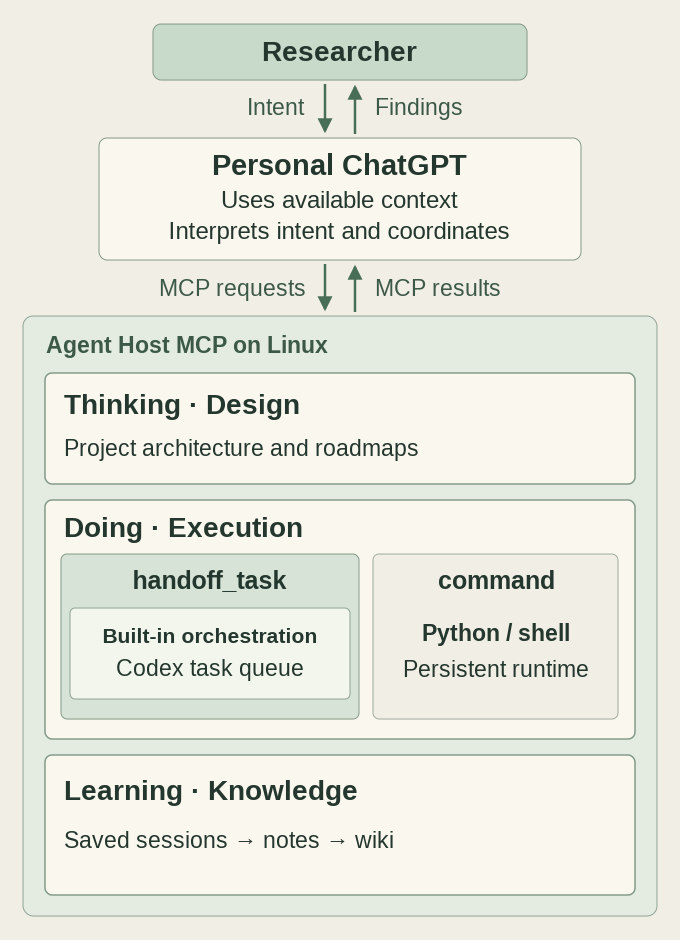
That is the role I wanted ChatGPT to play in Agent Host MCP. It translates a partly formed intention into an objective that Codex can work on in a defined workspace. It can help write the plan, pass along the context relevant to each task, and bring evidence back into the conversation. We can interpret that evidence and decide what question to ask next. I keep responsibility for the decisions, the authorization to act, and the scientific judgment.
The problem I wanted to solve
A research day moves between these kinds of work. I may begin by comparing two estimators, switch to implementing one of them, and then run a script with fixed inputs. The next day I may want to find out why we changed a convergence check. If everything lives in one chat or coding session, a tentative idea can turn into an implementation request, a known procedure can become another agent task, and a useful finding can disappear into the transcript.
I designed Agent Host MCP to give each kind of work a place. Thinking, doing, and learning are three stages of focus that I can return to as the study changes. A run may reveal an assumption worth discussing again. A note from an earlier study may change what I want to test before I run anything.
Thinking. Give the design a place to live.
Suppose I want to compare ordinary least squares with a Student’s t likelihood fit when some measurements have unusually large errors. We can spend a whole conversation on the hypothesis. What would make this a fair comparison? Should the two estimators see exactly the same simulated datasets? How will we count failed fits? Better answers to those questions are useful research even if I close the conversation there.
architecture_design reads and writes the project’s architecture Markdown, where I can record methodological choices and constraints that should outlast a single run. build_roadmap reads and writes numbered Markdown plans for scoped steps and acceptance criteria. Both stop at the document. Writing implementation code or starting another Codex agent takes a separate action that I choose to authorize.
Doing. Decide what kind of execution I need.
When I know the objective and need somebody to work out how to meet it, I delegate it to Codex with handoff_task(action="run"). If I want Codex to implement an approved roadmap, the coding action breaks the selected plan into tasks, implements and tests the changes, reviews them against the architecture and roadmap, and makes repairs where needed.
Once I have a script and know which inputs to use, command(action="execute") can run the supplied Python or shell in a persistent host runtime. This path executes the procedure directly without starting a reasoning agent. I can specify exactly what the host is asked to run. Reproducibility still depends on the data, seeds, software versions, hardware, and numerical settings.
Learning. Keep findings I can use again.
The Markdown says what we intended. A saved session records the experience of doing the work, including dead ends and reasons for changing the plan. When I start a related study, I may want to recover just one finding, such as a diagnostic that helped explain a convergence problem.
build_knowledge distills material from saved sessions into persistent notes. The wiki tool can search and read them without starting another model turn. The knowledge lives in retrievable records that can outlast the session. A note can preserve a mistake as faithfully as a good idea, so I still want to check it against the evidence and ask whether it applies to the new study.
Where the dependency graph belongs
Once I have an agreed protocol for the estimation study, three tasks can start from it. One can work out the assumptions of the two estimators. Another can build the simulation. A third can check the literature for related comparisons and any conditions we have overlooked. Integration needs all three outputs. An independent check can then test whether the integrated code follows the protocol, including how it records failed fits.
ChatGPT can infer those dependencies from what each task needs. Once I authorize the work, it can submit the independent tasks and use their returned runtime IDs to queue integration and verification up front. The queue inside handoff_task enforces successful prerequisites and concurrency limits, and it runs tasks that share an agent or saved session one at a time. It starts eligible jobs and tracks their state without asking a model to make each scheduling decision. I put the scheduler where task state already lives, so the same handoff coordinates submission and execution.
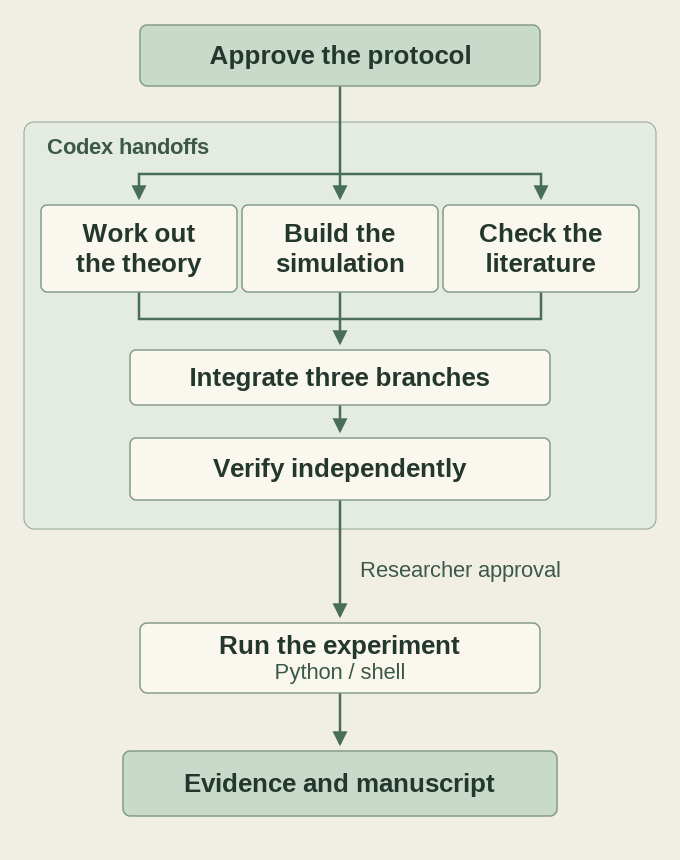
The submitted dependencies form a directed acyclic graph. If a prerequisite fails, the scheduler holds the tasks that need it. If verification exposes a flaw in the protocol, I can decide whether to repair a task or submit a new graph. The research can come back to an earlier question without sending a scheduled task in a circle.
What I want to carry into the next question
For the hypothetical estimation study, I would want the protocol, source code, data or generator, settings, and figures that support the manuscript. If I make a PDF from LaTeX, I want to trace a table back to its run and be able to reproduce it. When ChatGPT brings me the files and the verification findings, I can inspect a particular discrepancy and decide whether it calls for another run or a different hypothesis.
That is what makes the conversation feel like a research workspace to me. I can spend time on the question while it is still open, give the host precise work when I am ready, and carry forward what survives review. A successful run can still test a poor assumption. I want the evidence close enough to the conversation that I can tell the difference.
When someone joins a study after several rounds, can they find enough of our reasoning to challenge a choice we have stopped questioning? I think that is a better test of what the workspace has kept than how much of the conversation it can recall.